
Why Most Nigerian Businesses Waste Money on Social Media
Let me say something that most agencies will not say out loud:
A lot of the money Nigerian businesses spend on social media is wasted. Not because social media does not work. Not because the market is too hard. But because the approach is wrong from the very beginning — and nobody stops to say so.
This post is that conversation.
If you have ever boosted a post and felt nothing, hired someone to “handle your social media” and seen zero growth, or spent money on content that looked good but did not bring in customers — you are not alone. And you are not the problem. The strategy is.
Let us get into it.
The Real Reason Social Media Is Not Working for Your Business
There is a pattern I have seen repeat itself across Nigerian businesses of different sizes and industries.
It usually goes like this: a business owner sees competitors posting online, decides they need to show up too, starts posting or pays someone to post for them, boosts a few things when they feel like it, checks the page after a few weeks, sees nothing meaningful, and concludes that “social media does not work for my kind of business.”
That conclusion is wrong. But it is completely understandable given everything that led to it.
The problem is not social media. The problem is that most businesses skip the most important step entirely — strategy — and jump straight to execution. They start spending before they understand what they are spending for, who they are talking to, what those people actually respond to, and what success is even supposed to look like.
You cannot build a house starting from the roof. Social media works the same way.

Mistake #1: Boosting Random Posts
This is the single most common way Nigerian businesses throw money away online. And it is easy to understand why it happens.
The “Boost Post” button is right there. Meta makes it simple. You put in a small amount, select an audience that feels about right, and hit go. It feels like marketing. It looks like marketing. But in most cases, it is not marketing — it is paid visibility for content that was never built to convert.
Here is the truth about boosting: boosting amplifies whatever is already in the post. If the post has no clear message, no defined audience, no compelling reason for someone to act — boosting it just means more people see something that was not going to work anyway. You have now paid to reach strangers with content that would not have moved your existing followers.
Boosting is not inherently bad. It can work when the post being boosted is strategically built — with a specific audience in mind, a clear message, and a defined outcome. But that is not how most businesses use it. Most businesses boost their best-looking post and hope something happens.
Hope is not a strategy.
What to do instead: Before you put money behind any post, ask three questions. Who exactly is this for? What do I want them to do after seeing it? Does this post give them a reason to do that thing? If you cannot answer all three clearly, the post is not ready to be boosted.
Mistake #2: Spending Before You Have a Strategy
This one is less visible but more expensive in the long run.
Many Nigerian businesses start spending on social media — whether on ads, content creation, or management — before they have answered the foundational questions that make any of that spending worthwhile.
Questions like: What is this brand actually about and who is it for? What kind of content builds trust with that specific audience? Which platforms are those people actually using? What does a customer journey look like from first seeing a post to actually buying? What does success look like in month one versus month six?
Without answers to these questions, every naira spent is essentially a guess. And guesses compound in the wrong direction — because you start building habits, content styles, and audience expectations based on an unclear foundation. Six months later, you have a page that does not really represent your brand, an audience that does not really match your customer, and results that do not really reflect your potential.
Starting with strategy is not slow. It is what makes everything that comes after it faster.
What to do instead: Before you spend anything, define your brand position, your target audience, your content pillars, and your goals. Even a simple, honest answer to each of those is enough to change the quality of every decision that follows.

Mistake #3: Measuring the Wrong Things
Reach. Impressions. Likes. Follows.
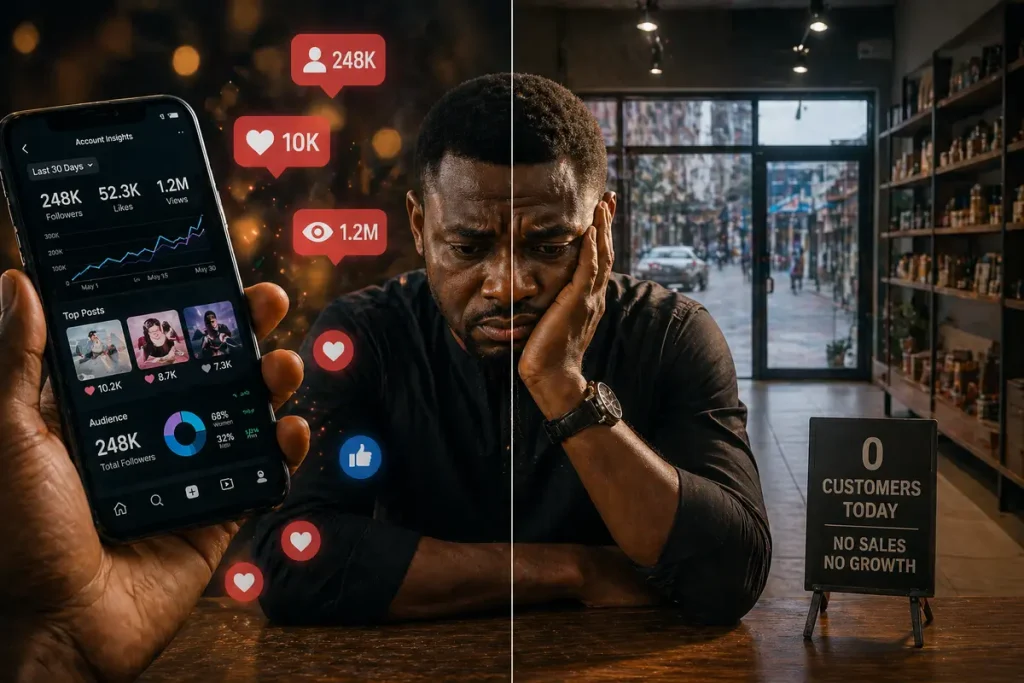
These numbers feel good when they go up. But for most businesses, they are not the numbers that matter. A post that reaches 10,000 people and generates zero inquiries has not done its job. A page with 5,000 followers that produces no sales is not an asset — it is a vanity project.
The metrics that matter are the ones connected to your actual business goals. How many people clicked through to your website? How many sent a DM asking about your product? How many converted from a follower to a customer? How many came back?
When businesses measure the wrong things, they make the wrong decisions. They chase content that gets likes instead of content that gets customers. They optimize for reach instead of relevance. They confuse activity with progress.
What to do instead: Define your key metrics before you start — and make sure they connect directly to your business goals, not just your page performance.
Mistake #4: Treating Social Media as a Megaphone Instead of a Conversation
A lot of Nigerian businesses use their social media pages the way they would use a billboard. Post the product. Post the price. Post the promotion. Repeat.
This approach misunderstands what social media is and how it builds businesses.
Social media works by building trust over time. Trust comes from consistency, from showing up with value, from letting your audience see who you are beyond what you are selling. People buy from brands they feel they know. And they get to know brands through content that teaches, entertains, challenges, or connects — not just content that sells.
The businesses that win on social media are not always the loudest. They are the most consistent, the most human, and the most useful to their specific audience.
What to do instead: Think of every post as a contribution to a relationship, not a transaction. Mix content that sells with content that serves. Let your audience see the thinking, the process, the people, and the perspective behind your brand.
Mistake #5: Hiring for Execution Without Demanding Strategy
“I have someone managing my social media” is one of the most common things Nigerian business owners say. The follow-up question — “what is the strategy they are working from?” — is usually met with silence.
There is a difference between a content creator and a social media strategist. A content creator produces posts. A strategist builds systems that turn an audience into a business asset. Both have their place, but they are not the same thing — and paying for one while expecting the results of the other is a recipe for frustration.
If the person managing your social media cannot tell you what your content pillars are, what your target audience profile looks like, how they are measuring success, and what the plan is for the next 30 to 90 days — you are paying for activity, not growth.
What to do instead: Whether you hire internally or work with an agency, demand a strategy before you approve a single post. The strategy should be documented, specific, and tied to your business goals.
How to Know If Your Current Approach Is Working: The SFA Test
At Nexo Socialis, we use a simple internal framework called the SFA Test to evaluate whether a brand’s social media presence is actually built for growth. It stands for Strategy, Foundation, and Audience.
Strategy: Do you have a documented plan for what you are posting, why, and for whom — or are you posting based on what feels right that day?
Foundation: Does your brand look, sound, and communicate consistently across platforms? Would a new visitor understand who you are and what you do within the first ten seconds?
Audience: Are you reaching the right people — the ones who are likely to become customers — or just accumulating followers who will never buy?
If the honest answer to any of those three is “not really,” you already know where the problem is. The SFA Test is not about judgment. It is about clarity. Because you cannot fix what you have not named.
What Good Social Media Management Actually Looks Like
When social media is working properly, it does not feel like guessing.
You know what to post because you have defined pillars and a content plan. You know who you are talking to because you have built an audience profile. You know what is working because you are tracking the right metrics and refining based on data. And you know what to do with the results because every piece of content connects back to a goal.
That is what a properly managed social media presence looks like. Not chaotic. Not reactive. Intentional, consistent, and compounding over time.

Frequently Asked Questions
Why is social media not working for my Nigerian business? The most common reasons are posting without a defined strategy, boosting content that was not built to convert, measuring vanity metrics instead of business outcomes, and not clearly defining the target audience before spending. Social media works — but only when the approach behind it is deliberate.
Is boosting posts on Facebook and Instagram worth it in Nigeria? Boosting can work, but only when the content being boosted is strategically built with a specific audience, clear message, and defined outcome in mind. Boosting a random post without those elements is paying to show ineffective content to more people.
How much should a Nigerian business spend on social media? Budget matters less than strategy. A business spending ₦20,000 monthly with a clear plan will almost always outperform one spending ₦200,000 without one. Start with strategy, then scale spend behind what is proven to work.
What should I look for in a social media manager in Nigeria? Look for someone who can present a strategy — not just a content calendar. They should be able to tell you your target audience profile, your content pillars, how they will measure success, and how they plan to refine the approach over time.
What is the SFA Test? The SFA Test is a framework developed by Nexo Socialis to evaluate the health of a brand’s social media presence. It stands for Strategy, Foundation, and Audience — the three pillars that determine whether a social media presence is built for real growth or just activity.
How can Nexo Socialis help my business avoid these mistakes? We start every client relationship with a social media audit that runs your brand through the SFA Test and gives you a clear picture of where you stand. From there, we build a strategy that makes every naira you spend work harder. You can request yours free at nexosocialis.com/free-audit.
Stop Guessing. Start Growing.
Social media is not the problem. The approach is.
If any part of this post felt uncomfortably familiar — if you recognised your business in the mistakes above — that is not a reason to feel bad. It is a reason to change the approach.
At Nexo Socialis, we help Nigerian businesses and brands across Africa stop wasting money on social media and start building presences that actually grow. We do that through strategy, content, community management, data-driven refinement, and ad campaigns that are built to convert — not just reach.
The first step is understanding where you stand right now.
Start with a free social media audit at nexosocialis.com/free-audit. We will run your brand through the SFA Test, show you exactly what is working and what is not, and give you a clear picture of what needs to change.
No pressure. No jargon. Just clarity.
— Nexo Socialis Building Africa’s next generation of digital brands.
